DEFINING THE ‘ATLANTIKWALL’
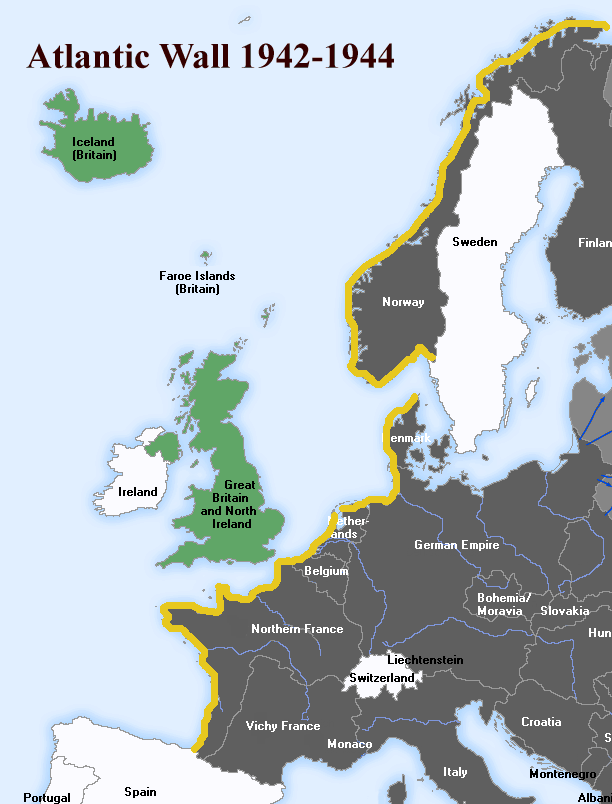
From our Dutch member, the Stichting Menno vcan Coehoorn we received this document, prepared for the « Erfgoedtafel Atlantikwall Zuid-Holland’ (Heritage Table province South-Holland), it being the first or at leastone of the first attempots at defining this phenomenon, that covered the coast from northern Norway, through Denmakr, German, Belgium and France.
The Atlantikwall, Definition of a Phenomenon
1. Introduction
It might appear that amongst historians and policy makers there is common conception of the Atlantikwall. There are however many interpretations. For this reason, an attempt has been made to approach the Atlantikwall not only as objectively but also functionally.
2. The Atlantikwall in Historical Perspective
a) Phases
There are four discernible phases in the development of the German coastal defences: Phase 1: Guarding the coastline, defending of key locations (harbours) and invasion preparations (1940-41); Phase 2: Linear closed defence line against sea-based attacks (late 1941); Phase 3: Comprehensive closed defence line against sea based and airborne attacks (late 1942-late 1943); Phase 4: Proactive defence and layered defence lines (late 1943-1944);
b) Prelude (Phase 1)
Guarding of the coastline, defence of key locations (harbours) and invasion preparations (1940-41). Early June 1940 saw the coastlines of Western Europe from the northern reaches of Norway to southern France in German hands. From then on this coast became the outer reaches of the third Reich. The Wehrmacht kept up, at this point only a primitive guard, as it was still on the advance. Any defences (occasionally bunkers) worth speaking of were placed at key points of strategic interest: ports and harbours on the West European Coast, the Channel Coast and the prestigious Channel Islands; for example. Following their losses at the Battle of Britain coupled with Hitler’s expanding Eastern interest, the Wehrmacht gradually began to fill in the forgotten gaps and remote points between their initial strongholds, using radar and artillery positions, thereby slowly forming a series of fortifications along the whole coastline.
c) The Order of 14 December 1941: Die Neue Westwall / the New Westwall (Phase 2)
Linear closed defence line against sea-based attacks (late 1941). On the 14th of December 1941 Hitler ordered the building of the Neue Westwall and with it came a better picture of the concept for the further expansion of existing strongholds into a sealed defence line “von Eismeer bis zur Biscaya”. This line would protect the important coastal locations, primarily the harbour areas, against enemy attacks from the sea and air, using of course “all available means”.
The defensive concept upon which the Neue Westwall was based, was the assumption that: the robust ability of the defences to take a prolonged pounding would provide sufficient opportunity to provide efficient reinforcements. A challenge, when considering the enormous lengths of coastline to be defended. On the one hand, these principles were dictated by the increased threat of the Allied invasion, and on the other hand by the demand for evermore troops at the Eastern Front. Besides, according to Hitler, the “Neue Westwall” was greatly symbolic and therefore also valuable propaganda. Its realisation turned out to be more challenging and this led to a change of plans.
d) The Benefits of Experience: the Atlantikwall (Phase 3)
Comprehensive closed defence line against sea based and airborne attacks (late 1942-late 1943). In less than one week of the Atlantikwall-Conference of 13th August 1942 the ill-fated Allied raid on Dieppe took place. It encouraged Hitler’s opinion that bomb proof bunkers, a so called Ständige Bunker, were called for to protect his field positions so vulnerable to air raids. This led to Order nr.14 being issued on 25th August 1942 by General Field-Marshal Gerd Von Rundsted, then Supreme Commander of all German troops on the Western front. It required an impenetrable fortress to be made of the Channel an Atlantic coastlines. This order meant a change of plans inevitable. To make the line impenetrable it needed protection from behind as well as up front.
The implications were the formation of a land-front corresponding to the sea-front, imperative to guarding the emplacements both from parachute attack behind lines and pincer attack movements. Tank traps were laid out with walls, dragons teeth , moats and canals were dug as water obstacles.
The expansion of the Sea-front with a land-front called for a further integration within and around the new and existing defences like the radar and airfield bases. This led to the creation of so-called Stutzpunktgruppen. The defence concept required far reaching cooperation between three military services Kreigsmarine, Heer and Luftwaffe.
e) Rommel (Phase 4)
Proactive defence and layered defence lines (late 1943-1944) Late 1943 field-marshal Erwin Rommel further changed matters as Hitler’s inspector of the Atlantikwall. He was of the opinion that an invasion attack should be destroyed at sea and in extreme circumstances on the beaches and that the Wehrmacht was unable to defeat the enemy should they be able to make a bridgehead and break out. Rommel ordered in early 1944 that placement of submerged obstacles and huge numbers of pikes buried at an angle rigged with steel cables and tipped with mines.
He recognized from previous encounters at the front, the increasing risk of allied airborne landings. To counter this danger and protect the rear of the coastal defences, Rommel ordered the existing Landfront and the hinterland expanded. Low lying areas were flooded, Rommel had additional minefields laid, earthworks and obstacles placed.
3. The Atlantikwall as phenomenon
The remains of the Atlantikwall are like war-scars. There are very few visible signs of the German occupation along our coastline. This realisation over the last few years has altered our appreciation of the Atlantikwall. The remains are protected cultural heritage sites.
For current and future stewardship of the Atlantikwall it is therefore important to gain insight into the nature of the defence line, for making balanced interpretations about the significance of (elements of) the Atlantikwall.
The Atlantikwall can be viewed in several different ways:
a military defence concept, based on a line; a discernible, physical infrastructure, mostly near or along the coastline.
- a largely standardized fortifications.
- An integrated defence system.
- a propaganda slogan
a) The Atlantikwall as defence concept
The Atlantikwall Neue Westwall built upon earlier German defence concepts based on lines, like the Ostwall and Westwall. The big difference to these lines is that Atlantikwall wasn’t built from one set of blueprints, but under influences of dynamic warfare and military strategy decision making it evolved from 1941 into an integrated defence system encompassing any existing coastguard elements along the West European Coast.
b) The Atlantikwall as physical infrastructure
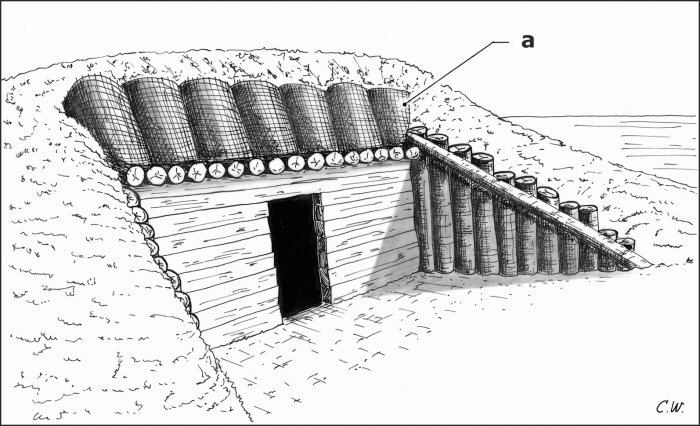
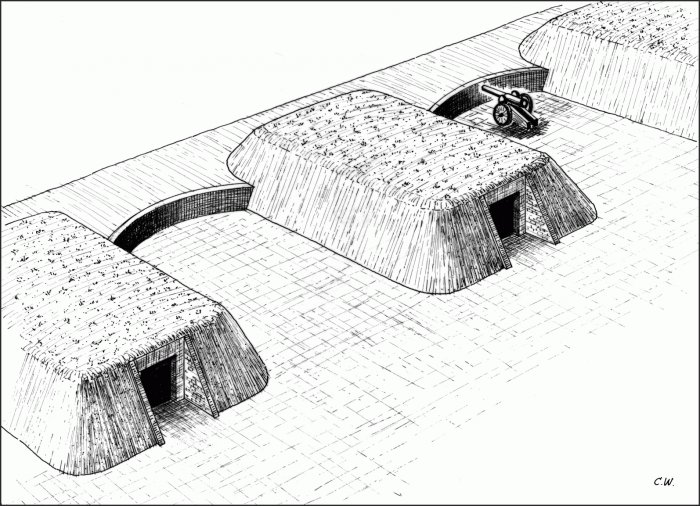
The German coastal defences that were established in 1940 were primarily aimed at the prevention and repulsion of enemy air and sea attacks. Originally comprised of varying artillery batteries located around harbours and along the coast. Around all these points and at spots in between, they built U-Boot Bunkers (Unterseeboot, Underwater boat / submarine), and S-Boot-Bunkers (Schnellboot, Speedboat / motor torpedo boat), anti-aircraft positions and radar installations were built. These objects and complexes lay within the same are of the defence line we now call the Atlantikwall, whereas they were never formally a part of it. Their presence born of tactical considerations meant they were simply included in the defences as much for their own protection as the added bonus they leant the Atlantikwall itself.
Résumé: The Atlantikwall exists as physical coastal defence structures consisting of individual objects and ensembles into which military objects have been integrated regardless of their own function. These objects continue to be seen as part of the Atlantikwall, even if strictly speaking this is not the case.
c) The Atlantikwall as defence system
The coastal defence could not function without the headquarters inland, in command and responsible for logistic support, communication and supply routes, etc. The so called fall-back emplacements, inundation zones and other barriers further inland are all part of the system. The give the depth and strength to the Atlantikwall.
Résumé: The evolving German coastal defence concept determined the eventual shape and size of the physical infrastructure of the Atlantikwall. The dedicated organisation, management and support made the Atlantikwall the functioning defence system it was.
d) The standardized fortification concept
The standardized fortification concept can be found in:
- the central management building the Atlantikwall and hierarchy within defence bases according to category: Widerstandsnest, Stützpunkt, Stützpunktgruppe and Verteidigungsbereich (Festung);
- the standardisation of bunkers and objects: Ständiger Bau, Küver, Verstärkt Feldmässig, Sonderkonstruktionen, etc.;
In German sources the line was also referred to as “Perlen am Perlenschnur” describing the strongholds as pearls with in between the “freie Küste” the coastline as the necklace.
e) The Atlantikwall as propaganda slogan.
The war reports, newspapers and magazines created an image of the Atlantikwall as an impervious wall making “Festung Europa” impregnable. This propaganda message would put the German people at ease, keep the soldiers’ moral high, suppress the occupied territory whilst discourage and demoralise the enemy.
4. Defining the Atlantikwall
Based on the previous analysis it possible to define, depending on the chosen perspective, what the scope is of the Atlantikwall, and which objects and defensive works can be included.
a) Borders
The physical borders of the Atlantikwall comprise:
– The outer borders of the fortifications and bunker complexes (Widerstandsnest, Stützpunkt), or combination of bunker complexes (Stützpunktgruppe, Verteidigungsbereich, Festung) both Seafront and Landfront as established by the Wehrmacht as coastguard;
– The stretches of coast between the various Stützpunktgruppen and Vertriedungsbereiche (Festung) with a variable depth of several kilometers land inwards.
b) Defence system
The elements that make up the Atlantikwall defence system also include all the hinterland units, positions and headquarters of the coastal defence forces. The length of the Atlantikwall stretches some 6200 kilometers, measured straight along the coast ignoring coves and fjords from the Norwegian-Russian frontier to the Franco-Spanish border, including the Channel Islands.
Literature: Huber, T. (2003). Der Atlantikwall 1940-1945. Die Befestigung de Küsten West- und Nordeuropas im Spannungsfeld nationalsozialistischer Kreigführung und Ideologie. Molt, A. (1993). Der Deutsche Festungbau von der Memel zum Atlantik. Fetungpioniere, Ingenieurkorps, Pioniertruppe 1900-1945. Rolf, R. (2014). Atlantikwall. Batteries and Bunkers.
Den Haag, 22 February 2016,
Kees Neisingh, Gert-Jan Mellink, Raphaël Smid, Jeroen Rijpsma